
.png)
Why cheaper AI will increase giants' revenue, not decrease them.
In 1865, a 29-year-old English economist published a book that would leave a lasting mark on economic thought: The Coal Question. In it, William Stanley Jevons studied a phenomenon that baffled British industrialists at the time. James Watt’s steam engine, far more efficient than the Newcomen engine that preceded it, consumed much less coal to produce the same amount of work. Logically, one would expect national coal consumption to fall. Instead, it skyrocketed.
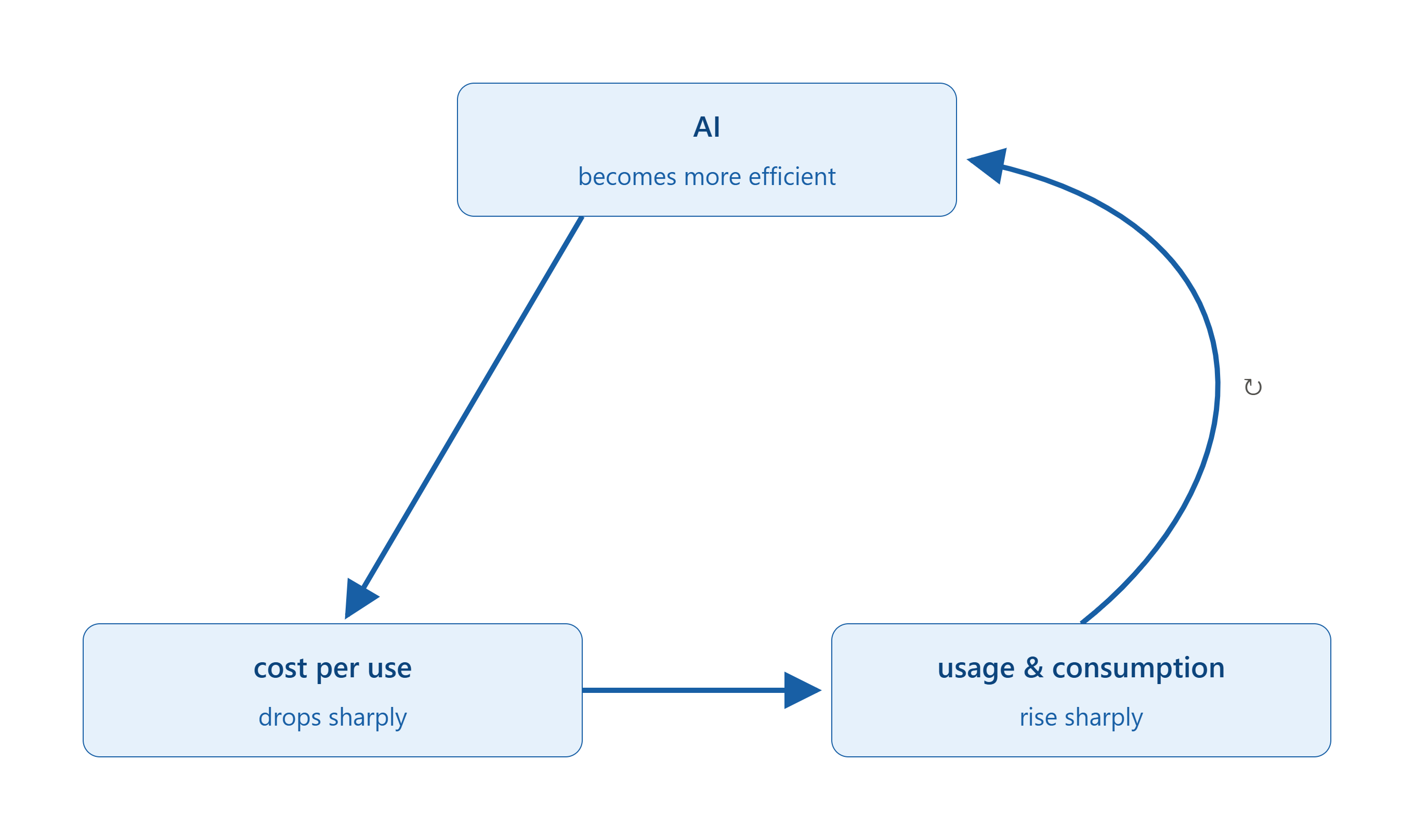
Jevons identified a mechanism as simple as it is counterintuitive: making a resource more efficient to use makes it cheaper to operate, and therefore more profitable to deploy, leading to its use in applications that would never have been justified before.
Efficiency does not reduce consumption. It multiplies it by opening up the resource to uses that were previously too costly to be profitable. Today, this phenomenon bears his name: the Jevons paradox.
160 years later, the same dynamic is playing out with artificial intelligence
Each generation of AI models costs significantly less to run than the last, for the same level of capability. The cost per query has dropped by 99% compared with GPT3. The natural intuition would be to think that the sector's overall bill/market should therefore stabilize, or even decrease: we are doing "more with less."
The opposite is happening—and Jevons would likely have predicted it. An AI that is cheaper to use is an AI that we plug into tasks we would never have entrusted to a model two years ago: proofreading an email, summarizing a meeting, generating a first draft of a spreadsheet, or querying a database in natural language. Each of these uses, taken individually, costs a fraction of a cent that it was before but mlultiplied by billions of daily interactions across the global economy, the volume of usage is growing faster than the unit cost is falling.
The client's consumption of AI is therefore not following a downward curve: it is climbing, driven not by the inefficiency of the models, but by their very efficiency.
What this means for you
This paradox is more than just an economic curiosity. For a CFO or CEO currently managing rapidly growing IT and AI budgets, it has a direct implication: do not budget for AI the way you budget for a traditional software license, where the cost per user remains relatively stable over time. AI behaves more like a resource whose unit cost decreases but whose usage—and therefore the total bill—has every structural reason to increase as the organization discovers new profitable use cases.
In practical terms, this calls for three key habits:
- Manage volume, not just unit price. A cheaper AI contract per token guarantees nothing regarding the total bill if usage multiplies in parallel—in fact, that is the most likely scenario.
- Anticipate the ripple effect. Each new profitable AI use case generally triggers others in different departments. The budget for year N+1 cannot simply be calculated by taking the year N budget and adjusting for price drops.
- Measure before scaling. As with any resource whose consumption can grow faster than expected, tracking data (usage, costs, value generated per use case) becomes the primary management lever—not an option.
Jevons studied coal. His reasoning applies today to the electrons powering AI data centers—and, on our scale, to your company's AI budget.
The lesson has remained the same since 1865 : when a resource becomes cheaper, the right question is not "how much will we save?", but "how much more will we consume, and are we equipped to see it coming?"